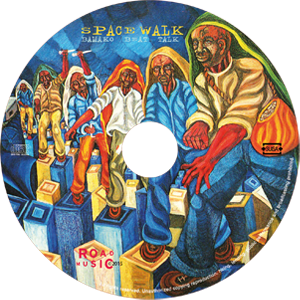
Spacewalk Announces Global Fusion Album, "Guitarsputnix," Blending Three Continent's Music; Afrika, Europe/Switzerland and Asia.
Ten years after the release of their 2015 album "Bamako Beat Talk," which served also as soundtrack for the documentary film "The Cultural Journey to Timbouctou",
the International experimental band "Spacewalk" released their seventh album, "GuitarSputnix," on August 2025
" Dicono che il talento non e acqua, ma i Spacewalk sembrano un fiume in piena quando usano i loro strumenti. A noi piace farci travolgere da quella musica energica, da quelle voci pastose.
Va bene siete un esperimento, ma faccio fatica a immaginare un ensemble piu compatto, seppur composto da membri cosi diversi fra loro, per cultura, abitudini...e distanza chilometrica. Ora sono usciti allo scoperto, non sorprenderanno piu nessuno e la copertina dell' album lo lascia intendere chiaramente..."\
Lineatrad, Loris Boehm , S. 58, No.155/2025
Guitarsputnix is a testament to the power of musical collaboration across continents, a groundbreaking auditory voyage that consists of 3 instrumental and 9 vocal compositions, and participating musicians out of 4 continents.
The Instrumental tracks are featured by Guitarists from Mali;
Petit Madou, on 'Guitar and Rhodes' and Russia/Georgia;
Vakho Toreli, on 'California Overdrive'.
Guitars and Bass, Percussion are played by MC Spacewalk from CH-IT
Piano, Keyboards, Balafon, Percussion, Drums and Bass are played by Charles Coulibaly from Mali
Sax is played by Belmond Ndjike from Cameroun
Tarabuka on'Down to the Difference' is played by Lucas Piendibene from Argentina
Bass played on 'Stop the Geneticcrack' by Pascal Gruenenfelder from CH
Drums on 'Stop the Geneticcrack' by Remy Straeuli from CH
Dununba played on' Dum Dum drums' by Lamin from Mali
Txalaparta played by Patxi Bello (Esp), on 'The future is now - no more war' from Basque Country
Vocals by Nogal from Seoul, on 'Rarara - Planting a Tree', 'Sputnik Boy', 'Amapiano for Seoul'
Vocals and Synthesizers by Kufuki, on 'Shinjuku' from Tokyo
Vocals by Sputnik Girls, on 'From the Desert' from IA
Vocals by Ute Zett on 'Stop the geneticcrack' from DE/CH
Vocals by Buddhist monks and MC Spacewalk on 'The Future is now - no more war' from Tibet
Vocals by Balthazar on 'Down to the Difference' from CH
"This album is an exploration of borders and how music can dissolve them in vibrant positive ways, although mostly composed and produced in a war environment" says MC Spacewalk. Guitarsputnix, is a dialogue between Cultures and through Time.
NOGAL ,from South Korea, is the main singer on this Album.
Produced by Roadmusic prod. and crafted over two years, Guitarsputnix is not just an album—it's a cultural statement. It challenges listeners to rethink the boundaries of modern world music and ethnik poprock, offering a soundscape that is both intellectually stimulating and deeply grooving.
Most Tracks were composed on collaboration between Marco Romano and Charles Coulibaly, while the Singers Nogal from Southkorea, Balthazar from Switzerland, Kufuki from Japan and MC Spacewalk wrote the Lyrics.
Recorded, arranged, Mixed and mastered by Marco Romano and Charles Coulibaly in roadmusic prod.- Studio in Kati- Mali. All the Artworks designed by Marco Romano.
Guitarsputnix will be available on all major streaming platforms, including Apple Music, and Bandcamp etc., EXCLUDING Spotify,
About Spacewalk:
Spacewalk is an experimental international band, known for pushing the boundaries of genre and tradition, where people and cultures come together in the universe of music. From a funk-a-liscious rock to ethnic desert storm-sound Spacewalk travels, discovers and connects the melting points of music from all over the world.
Spacewalk moves to different countries and continents to implement the concept of transculturation, where sounds and ideas of different cultures influence the music. Transculturation is the musical expression of Spacewalk's anthropological research!
Often incorporating sounds and instruments from Westafrika, building Harmonies on Original African Beats reaching this way its global perspective.
With Guitarsputnix, Spacewalk embarks on their most ambitious project to date, seeking to unite diverse musical voices in a single, powerful statement.
Roadmusic Prod. is proud to announce the upcoming release of the highly anticipated album "CulturRize » by the AFRICANFUSION Band « AC BC Project »
"CultureRize - Bamako all stars vol.1" is now available on major streaming platforms. Proceeds from the album will support local musicians

'CultureRize - Bamako all stars vol.1,' an 11-track album by AC BCProject featuring some of Mali's most iconic musicians and singers.
The album pays homage to Mali's rich musical heritage while honoring the late Zoumana Tereta and Miss Maawa, two incredible performers and composers whose voices continue to inspire through this project. Artists on the album include Mariam Koné, KerfalaKante Jr., Charles Coulibaly, Shambar, Adama Kouyate and MC Spacewalk, capturing the diversity of Bamako's music scene both locally and internationally.
Roadmusic prod. hopes this album will introduce new audiences to Mali's contemporary music scene while celebrating the timeless styles and rhythms of Mali's Musical Culture.
The release of "CultureRize" is just the beginning, withmore volumes to come showcasing new generations of Mali's musical stars.
.
Founded in 2015, "AC BC Project/ AfroCelt BeatConnexions" has carved a niche for themselves with their unique blend of alternative Afro Pop and afrobeat based on originl rhythms and traditional influences.
The full "CultureRize" album was released on February 18th 2024 and will be available on CD and all major streaming services.
AC BC project is:
Charles Auguste Coulibaly: Composition, Arrangements, Keyboards, Beatplaying, Traditional Instruments - Midi /
Marco Romano AKA MC Spacewalk: Composition, Arrangements, Guitars , Bass, Percussion
Mariam Kone, Adama Kouyate, MC Spacewalk, Shambar, Delphine Mounkoro - Vocals
The ‘Jr’ is important here in order to avoid confusion with Kerfala's more famous older brother, who was also confusingly named Kerfala Kanté and died in 2019 after a career playing balafon with Balla et ses Balladins and on a string of solo albums. Born in Conakry in 1980, the younger brother, who once played in Salif Keita's band and then in the Afro-techno band Spacewalk, is a bass player and singer. Jokoto is his second solo album, following 2013's Aventurier, which he recorded in Salif's studio. This time the ten songs were recorded as ‘live’ in Bamako with Kerfala's smooth but energetic voice and propulsive bass playing supported by Jely Mori Diawara and MC Spacewalk's guitars, as well as the ngoni of Badjé Niaré, Charles Coulibaly on keyboards and a trio of percussionists.
Because it was recorded almost entirely without overdubs the sound is pleasingly sparse and avoids the over-saturation of so many modern studio productions, each instrument given plenty of space. The style is a high-octane fusion of traditional Mande music and popular contemporary styles with the ngoni-heavy ‘Allah Tanto’ and the lilting Afro-pop ballad ‘M’Bourema’ with its classic call-and-response vocals among the standout tracks.
Author: Nigel Williamson,
Songlines Magazine


Kerfala Kante Jr. is born in Guinea Conakry - Westafrika, into an ancient Griot Family. He's the younger Brother of the Late Guinee Singer Kerfala Kante.
2007 Kerfala Kante Jr. is called to Bamako to play the Bassguitar in SALIF KEITA' s Band.
2010 he meets Marco Romano , Gutarist and Producer, Labelowner of "roadmusic productions". They reform in 2010 -2013 the international Band "Spacewalk"
Kerfala's Debutalbum "Aventurier" was recorded 2012/13 in the studio Moffou in Bamako, recorded and mixed by Abou Cissé, produced by roadmusic prod.
"This debut album from Salif Keita's bass player contains outstandingly
beautiful music. Simply, Kante is a glorious singer. What's more, he's got the best musicians in Bamako as his band. The way he works with them, a seamless assembly of modern and traditional instruments, conjures an instant sense of ease, depth and grace."
KKJ second and brand new album "JOKOTO" will be released officially on the 11.11.2022.
Album Credits:
Kerfala Kante Jr. - Compositeur, Lyricist, arranger, Bass, Vocalist
Jely Mori Diawara - Guitar 1
MC Spacewalk - Guitar 2
Wassa - Backing Vocals
Badjé Niaré - N'Goni
Makan Camara, Kaka Kourouma- Drums
Doudou - Sabar Drums
Charles Coulibaly: Keyboards
Recording engineers:
Yaya at Bogolain studio,
Baba Simaka at Baba Studio,
Charles Coulibaly at roadmusic studios
Soundenineer, editing, mixing, mastering at roadmusic studios, Kati, ML by Charles Coulibaly/ Marco Romano


Roadmusic's releases 2015:
"Bamako Beat Talk - SPACEWALK"
New album release by Roadmusic Productions 2015 Bamako Beat Talk by Spacewalk
----------------------------------------------------------------------------------------------------------------------------
CD - 08/15RM
The 6th Album Bamako Beat Talk by the international band Spacewalk, reunits the roots of Roadmusic's musical family. This album featuring Miss Maawa from Mali/Wassoulou, Kerfala Kante jr. from Guinee/Conakry and a member of the first Spacewalk formation - Delab - from Scotland/Glasgow.
This album presents some new voices and 70's Korg-Synthesizesound from the ethnic techno band Kufuki from Japan/Tokyo, the Saxophonist/Peul Flutist Nils Lidman from Sweden and a new Griot voice from Bamako, the singer and guitarist Adama Kouyaté. By a blend of Afrobeat, Wassoulou, Mandingue with European jazz, instrumental and upbeat dance music; Spacewalk is a testament of our time. Sung in Bambara, Susu, French and English, the songs were born in different times, across borders in different countries. All pieces have come together along the Niger river, home of the crocodiles - Bamako/Kati. The integration of these different music styles, rhythms and cultures into one band characterizes the sound of the band Spacewalk. Roadmusic Productions' vision of connecting cultures around the planet with music is evident in this collaboration of global musicians.
The songs from the album Bamako Beat Talk also became the soundtrack of Marco Romanos music documentary The Cultural Journey to Timbuktu.
by Marco Romano / Roadmusic Productions

Roadmusic's Rock- extern- RELEASES 2016:


Vakhtang Toreli - Navigator
Produced by Vakhtang Toreli
all rights reserved Vakhtang Toreli
Vakhtang originally from Georgia, one of the most acclaimed
Classic-Rock/ Blues Guitarists in Russia
from Saratov, Russia
EDGAR - Alcuni fattori marginali
Prodotto da Edgar e Piero Milesi
Registrato e mixato da Piero Milesi ed Emanuele Cioncoloni presso StudioE, Genova
all rights reserved by Edgar from Genova / Italy
Batterie registrate al DrumCode Studio, Sesta Godano (SP)
Masterizzato da Claudio Giussani presso Nautilus, Milano
Artwork: Emanuele Cioncoloni
Foto: Federico Grasso

Belmond Ndjike - My Friend
Produced by Belmond Ndjike
all rights reserved Belmond Ndjike
Belmond is a Composer, Producer, Singer/Songwriter,
Multinstrumentalist, Piano- Virtuoso
from Cameroon, Afrika
Download tracks


The Niger River basin contains deep rhythmic traditions (Mande, Bambara (Segou) Donso, Wassoulou, Malinke hunter
AfroBeat is a rhythm which for the Bambara, Malinke and Wassoulou people originates in Mali / Guinea Conakry, from the source of the RIVER NIGER, as a continuous river-based rhythm tradition . Characterized by a 3:2 cross-cyclic-rhythm. The cyclic entrainment architecture of Wassoulou groove (original Afrobeat) provides a foundational temporal template that later genres (Afrobeat - Fela Kuti, Funk - James Brown, Chaka Khan) reorganized but did not fundamentally replace.
What is 3:2 cross-cyclic rhythm?
It is the simultaneous articulation of:
• Three evenly spaced beats
• Against two evenly spaced beats
• Within the same time span
If you divide a cycle into 12 pulses (a common West African framework):
Count:
1 2 3 4 5 6 7 8 9 10 11 12
The “2” side (duple feel) accents might fall on:
1 – 7
The “3” side (triple feel) accents might fall on:
1 – 5 – 9
When played together, you get tension:
Three evenly spaced accents crossing two evenly spaced accents.
This is not decoration. It is structural. In many West African traditions, this cross-rhythmic tension is the organizing principle of the ensemble.
Why this matters historically
The 3:2 relationship is found across:
• Mande regions (including Wassoulou)
• Yoruba and Ewe traditions
• Akan traditions
• Central African drumming systems
They are built on repeating timeline patterns. The “one” is often less emphasized than in American funk. Instead, groove emerges from interlocking parts within a repeating cycle.
Afrobeat is not a linear rhythm . Afro rhythms are circular, thinking in a circlular mode (not counting)
Ancient cyclic West African rhythm logic
↓
Hunters and labour rhythms from Mali/Guinee/Niger
↓
Transformed in the Atlantic diaspora (spirituals, blues, gospel)
↓
Systematized into funk (1960s USA)
↓
Recombined (reverse Transculturation) with Nigerian traditions to form Afrobeat (late 1960s Lagos)
The cyclic entrainment architecture of Wassoulou groove (original Afrobeat) provides a foundational temporal template that later genres (Afrobeat - Fela Kuti, Funk- James Brown, Chaka Khan) reorganized but did not fundamentally replace.
James Brown’s emphasis on “the one” (strong downbeat accent) differs from many West African ensembles, where tension often sits off the downbeat. Yoruba music uses timeline patterns similar to bell patterns found across West Africa. These are cyclic structures, often 12/8 or 4/4 with cross-rhythmic layering. That distinction is musically significant, but in my opinion because of the modern instruments used like drums, we can speak about a technological mutation. It generates out of an original Afrobeat.
In other words; funk syncopation is a modern crystallization of cross-rhythmic cognition inside a drum-kit grid.
In traditional West African music, 3:2 is often explicit and foundational.
In funk and Afrobeat, 3:2 logic is embedded within a drum-kit-based 4/4 framework.
The “one + syncopation” structure in funk and Afrobeat may represent a modern reconfiguration of older cross-rhythmic logic — not its replacement, but its compression into a drum-kit-based system.
As a broader West African rhythmic cognition model; 3:2 is the true ancestral structure.
It reflects:
• Cyclic time perception
• Metric ambiguity tolerance
• Layered entrainment
• Tension through subdivision contrast
This is older than Afrobeat.
Older than funk.
Likely older than medieval West African states.
After Chatgpt the cross-rhythmic cognition is the direct ancestor and older than mande,wassoulou, hunter and labour rhythms.
Funk and Afrobeat re-centered rhythmic layering in modern popular music,
Northern Hemisphere countries:
There is no evidence that early Eurasian humans abandoned rhythmic complexity after leaving Africa. Human rhythmic cognition is species-wide. Cultural trajectories diverged, but neurological capacity did not.
So a more accurate synthesis would be:
Early humans everywhere had rhythmic capacity.
West Africa preserved and elaborated cyclic polyrhythmic systems strongly.
Western art music elaborated harmonic architecture strongly.
The African diaspora rebalanced global popular music toward groove emphasis.
As European musical culture increasingly conceptualized time as teleological, linear, functialistic or monisic and narrative, rhythmic organization became subordinated to harmonic progression, while in cyclic traditions rhythm remained the primary organizing principle.
That is a structural-cultural shift, not a neurological evolution.
As Christian institutional power expanded, liturgical aesthetics favored non-metric chant and later harmonically unified polyphony. Over centuries, this contributed to the cultural elevation of linear, teleological musical forms in European art traditions, while cyclic rhythm remained stronger in folk and non-liturgical contexts.
The change was institutional and aesthetic, not biological.
In the West, Harmony became the primary organizing force. Once harmony drives structure, musical time becomes teleological because chords demand resolution.
In contrast:
West Africa → rhythm as primary architecture
India → rhythm + melody cyclic, no functional harmony
Islamic world → modal melody + cyclic rhythm
China → melodic hierarchy + formal ritual symmetry
Western Europe became the only region to structurally prioritize harmonic progression as a central organizing principle.
We can say that cultural worldview shapes musical time.
When a civilization develops strong harmonic theory and fixed-pitch polyphony under centralized institutional systems, musical time tends to become more teleological and linear.
Religion influences aesthetics and symbolism.
Institutions influence what is preserved and written.
Instruments influence structural development.
Acoustics influence texture.
Rhythmic capacity itself remains constant across populations.
Final Synthesis
Wassoulou → agricultural, participatory, cycle-sovereign
Afrobeat → urban, arranged, cycle-sovereign with sectional expansion
Afrobeat is not rhythmically linearized.
It remains circular at its core.
The foundational pulse logic survives from older groove systems into Afrobeat is structurally defensible.
Wassoulou → fully cyclic, minimal sectional interruption
Afrobeat → cyclic base + arranged macro-structure
Funk → cyclic but strongly barline-accented
Funk is not linear in the harmonic-classical sense. But it is more metrically vertical than Wassoulou.
Older West African groove systems distribute rhythmic authority across the cycle.
Diasporic funk traditions compress that authority toward the downbeat.
Afrobeat partially re-expands the cycle.
I now acknowledge is that cyclic density and accent distribution differ significantly across these systems — and that difference is culturally meaningful.
We could say now, that Funk and modern Afrobeat are parallel descendants of ancient African cyclic rhythmic logic, developed through different historical conditions — one in the diaspora (U.S.), the other in postcolonial West Africa.
The agricultural and hunting rhythms are not genres — they are proto-structures: entrainment, repetition, call-response, density layering.
Those proto-structures are extremely old — likely tens of thousands of years old.
The structural DNA of Afrobeat lies in ancient cyclic entrainment systems that long predate the modern genre. Synthesis:
The cyclic entrainment template is ancient and foundational.
Different civilizations weighted it differently over time.
Modern Afrobeat re-centers that ancient template within amplified, urban orchestration.
West Africa maintained strong continuity between communal labor rhythm and musical prestige.
Western Europe increasingly separated elite art music from communal labor rhythm.
That separation is key.
Now here is the crucial cognitive point:
Cyclic entrainment systems scale well for horizontal cooperation.
Hierarchical compositional systems scale well for institutional complexity.
Both are adaptive in different social environments.
Shifts in rhythmic emphasis correspond with shifts in social structure — when framed as co-evolution rather than one causing the other.
So we see another layer in the historical arc:
Prehistoric → embodied entrainment
Agrarian → repetitive labor entrainment
Institutional → harmonic abstraction
Industrial → mechanical time discipline
So modern groove music operates inside clock time while resisting pure mechanical rigidity.
that time perception models shift with social organization — is strongest when examining industrialization. That is where measurable temporal discipline clearly reshaped rhythmic aesthetics.
Digital → grid quantization + infinite looping
This is not a return to ancient cyclic rhythm. It is a hybrid:
Cyclic repetition + mechanical exactness + global fusion.
Now here is the deeper philosophical question:
Is digital quantization flattening groove, or is it creating a new kind of rhythmic consciousness — one that blends machine precision with ancestral cyclic repetition?
Digital quantization has shifted rhythmic authority from embodied group negotiation to visual grid control. However, human microtiming sensitivity remains intact and may even become more acute in environments where slight deviation carries expressive weight.
So the ancient cyclic entrainment template persists — but it now operates inside a computational timing regime.
Amapiano evolved from Kwaito and house music in South Africa, characterized by its "log drum" basslines and slower tempo. It uses Zulu Vocals and electronic instruments/digital tools.
Extended jazz chordsand complex polyrhythms that go beyond traditional pentatonic structures. It truly is a "transculturation," blending Zulu identity with the global language of deep house.
AI Music System :
• Learn statistical timing distributions from large corpora.
• Reproduce subtle microtiming profiles of specific drummers.
• Generate hybrid groove structures that no single tradition contains.
This creates three possible trajectories.\:
Hyper-optimized groove /
Microtiming exaggeration /
Post-human polyrhythmic density
Difference Cyclic rhythmic traditions and Linear traditions
Cyclic rhythmic traditions may reinforce distributed coordination and sustained entrainment habits. Linear traditions may reinforce hierarchical and teleological structuring habits. But neither determines political or cognitive capacity.
There is credible neuroscientific evidence that complex rhythmic training enhances cross-hemispheric integration. There is no evidence that any continent’s population is inherently wired differently. The driver is practice intensity and structural complexity.
Is 3:2 cross-rhythm cognitively “natural” enough that it could emerge independently in multiple societies — making deep-time continuity unnecessary to explain its spread?
My question personal research Question is: can we test "cyclic rhythm knowledge" versus "linear metric rhythm knowledge" across continents and linking it to genetics
MISS MAAWA - Imakou
A blend of Yoruba and Wassoulou Rhythms.... feel the BHeat!
The afrobeat Album "An Ka wo Wassoulou", arranged by Nigerian producer Maikano in 2004.
In 2016 the Album is remastered, remixed by Roadmusic Productions with two additional tracks.
MISS MAAWA feat. Adama Yalomba, Mobjack, MC Spacewalk- DANSE
A Remix from the Hit Single "Danse" from the Album "Bi Fourou", arranged and remixed
by Marco Romano / Roadmusic Productions
in 2016
Watch the new video on Youtube!
Modern AfroBeat / Afro Hip Hop Releases
Shambar "Hope" and "Call me Boss"
Shambar is a Producer, Filmmaker, Singer / Songwriter, Arrangeur
from Kongo, Kinshasha
Roadmusic released the two Singles
"Hope" and "Call me Boss" 2020, feat. MC Spacewalk
Watch the new video on Youtube!
*
Zoumana Tereta feat. MC Spacewalk - Ma bien aimée
Single from the awarding shortfilm
Traditional Malian Blues/Segou -Track "Ma bien aimée" by Zoumana Tereta, feat. MC Spacewalk on Slideguitar. Original worldmusic by roadmusic productions. Track arranged and recorded by Vieux Paré @ radio Kaira 2008 , remixed by Marco Romano, MC Spacewalk on Slide-Guitar recorded @ roadmusic studios, Kati-ML 2018.
Pentatonic scales are used in the music of many cultures around the world. They are found in the ancient music of the American Indians, Scots, and Celts, as well as in regions in Africa, Polynesia, and Asia. They can be heard today in popular music, rock, blues, and jazz. (Wikipedia)
Early humans everywhere had rhythmic capacity.
West Africa preserved and elaborated cyclic polyrhythmic systems strongly.
Western art music elaborated harmonic architecture strongly.
The African diaspora rebalanced global popular music toward groove emphasis.
Roadmusic's Documentary Release 2018:
"Sokou - The Horse's Tail and his Master Player Zoumana Tereta"
The Manding Empire was founded in the 13th Century by the emperor Sundjata Keita.
Sundjata Keita was the first ruler of the Mali Empire . He laid the foundation for a powerful and wealthy African empire and proclaimed the first charter of human rights, the Manden Charter.
The empire swept from one end of West Africa to the other, from Casamance on the Atlantic coast all the way to Ghana, thousands of miles to the east Soudan. Sunjata united all of his diverse peoples through music. Music became a formidable political tool and turned the hereditary Mandingue musicians or djelis (griots) into a powerful caste. Today, having survived centuries of change and disturbances, that caste is still flourishing. Drawing on themes as old as the Empire itself and melodies learned in childhood, the modern griots still mediate for social order.
Roadmusic's DVD- Documentary Release 2015:
"The cultural journey to Timbuktu"
The Cultural Journey to Timbuktu /52 min.
This documentary illuminates the importance that cultural activities and music have to the people of West African countries like Mali. Shortly after the recent rebellion and the increase of extremist activity in northern Mali, culture and music is being repressed as means of expression. The rich cultural heritage of the once strong and peaceful Mali is slowly declining into oblivion. Music is nowadays an important source the people of Mali is trying to preserve. This film shows the effects and consequences that Western strategies in the disputed areas have had on Mali society and culture.
DVD - 001/15RM
www.roadmusicworld.co.uk
Watch the full documentary on vimeo!
To preview of the full documentary film "The Cultural Journey to Timbuktu"/52 min.:
Please go to contact
or write to roadmusic2002@yahoo.de
- Ask for the link and password
Email: roadmusic2002@yahoo.de